
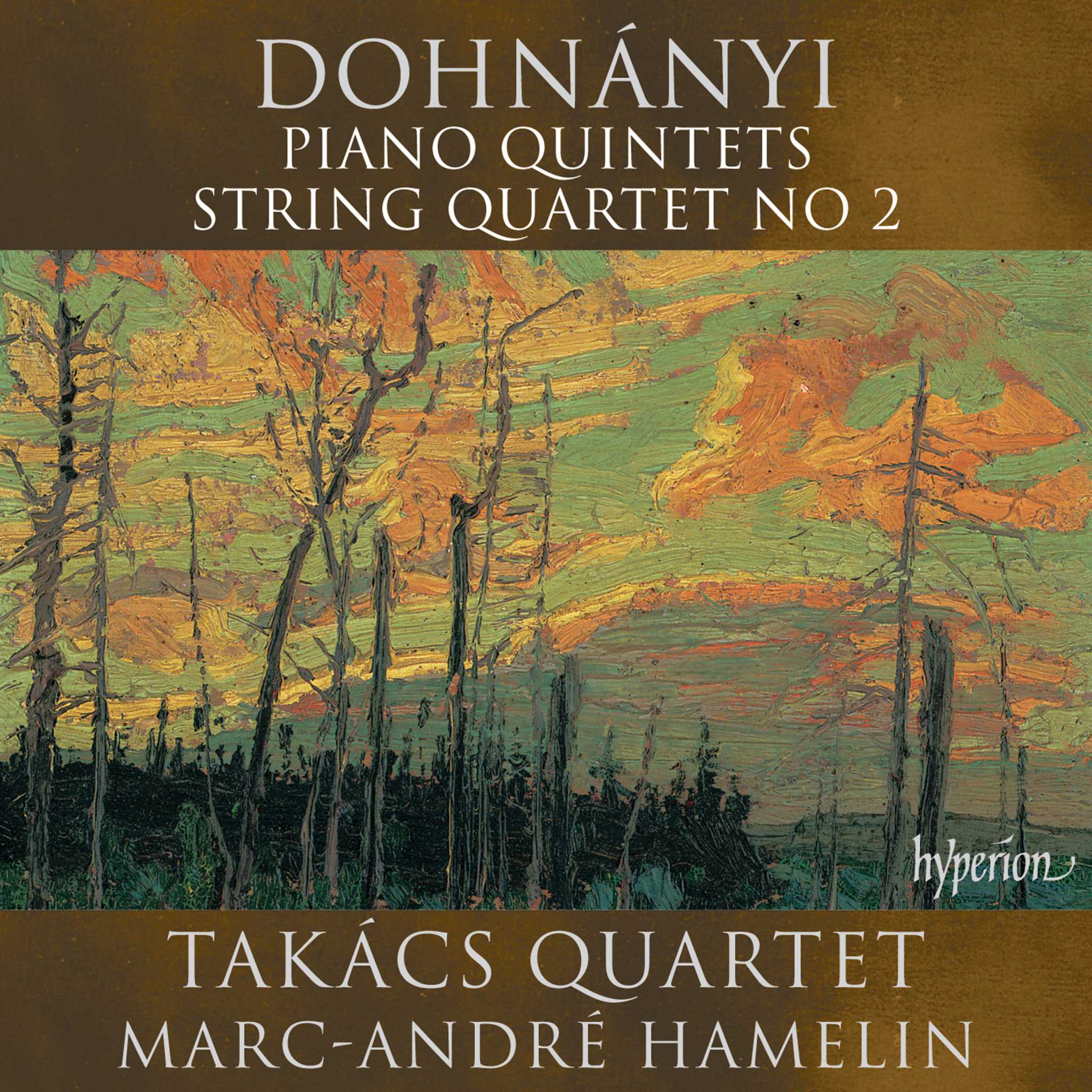




A more fulfilling start to a promising career as a composer is hardly conceivable. In the summer of 1895, the 17-year-old Ernst von Dohnányi was spending his summer break after his first year of studies at the Royal Hungarian Academy of Music. At that time, he received a postcard from Hans Koessler, his composition teacher, who was staying in Bad Ischl—where Johannes Brahms was also spending the summer. Dohnányi's Piano Quintet, which had been celebrated as a great success at its premiere recital, impressed Brahms. At his request, Arthur Nikisch and the Kneisel Quartet sent him the work, which so convinced Brahms that he organized a performance in Vienna on November 25 of the same year.
Anyone who hears the Piano Quintet No. 1 in C minor, Op. 1, understands why Brahms was so captivated. The four-movement work stands firmly in the Romantic tradition, demonstrates, even at a student level, an exceptional mastery of form and counterpoint, and impresses with its expressive power. In the first movement, the somber, march-like character of the Allegro, with its expansive melodic lines and a coda in C major instead of C minor, blends traditional approaches with new influences. The spirited, humorous Scherzo of the second movement reflects Dohnányi's distinctive style. In the "Adagio, quasi andante" of the third movement, the melodies are reminiscent of Robert Schumann. The Finale, an Allegro animato in 5/4 time, reprises the main theme of the first movement and brings the work to a celebratory conclusion.
At the same time, Dohnányi's adherence to Romantic traditions, which Brahms valued, met with disapproval from Hungarian modernists, who accused him of imitation. Critics complained that his music lacked independence. Despite these early objections, Dohnányi remained true to his conservative training. At the Budapest Academy of Music, he received a strongly German-influenced education and consciously avoided ethnological studies in order to develop his own Hungarian style. Instead, he emphasized that his origins should remain recognizable in his works.
After graduating in 1897, Dohnányi quickly established himself as a respected pianist and composer. He then accepted a position in Berlin, where he composed his String Quartet No. 2 in D-flat major, Op. 15, which, with its three movements and complex thematic interweaving, demonstrated his willingness to break away from traditional forms. The work concludes with a striking return to earlier themes. In 1914, Dohnányi achieved his greatest success with the Variations and Piano Quintet No. 2 in E-flat minor, Op. 26.
With his return to Hungary, the contrast between Dohnányi's musical orientation and that of the modernists intensified. As one of the leading figures in Hungarian musical life, he supported young composers like Bartók, but remained critical of modernism. In his role as music director of Hungarian Radio, he promoted numerous premieres but rejected some modern works, which led to criticism and envy. After leaving Hungary in 1944, Dohnányi was accused by some musicians of collaborating with the fascist government and betraying progressive composers.
The traditions instilled by Koessler and Brahms shaped Dohnányi's work for decades. While his music was initially criticized as outdated, a re-evaluation later took place, recognizing his works as significant contributions to late Romanticism. Despite initial reservations, Dohnányi's music, rooted in Romanticism, gained recognition, and his distinctive style was appreciated as the result of continuous development beyond the influences of Schumann and Brahms.