
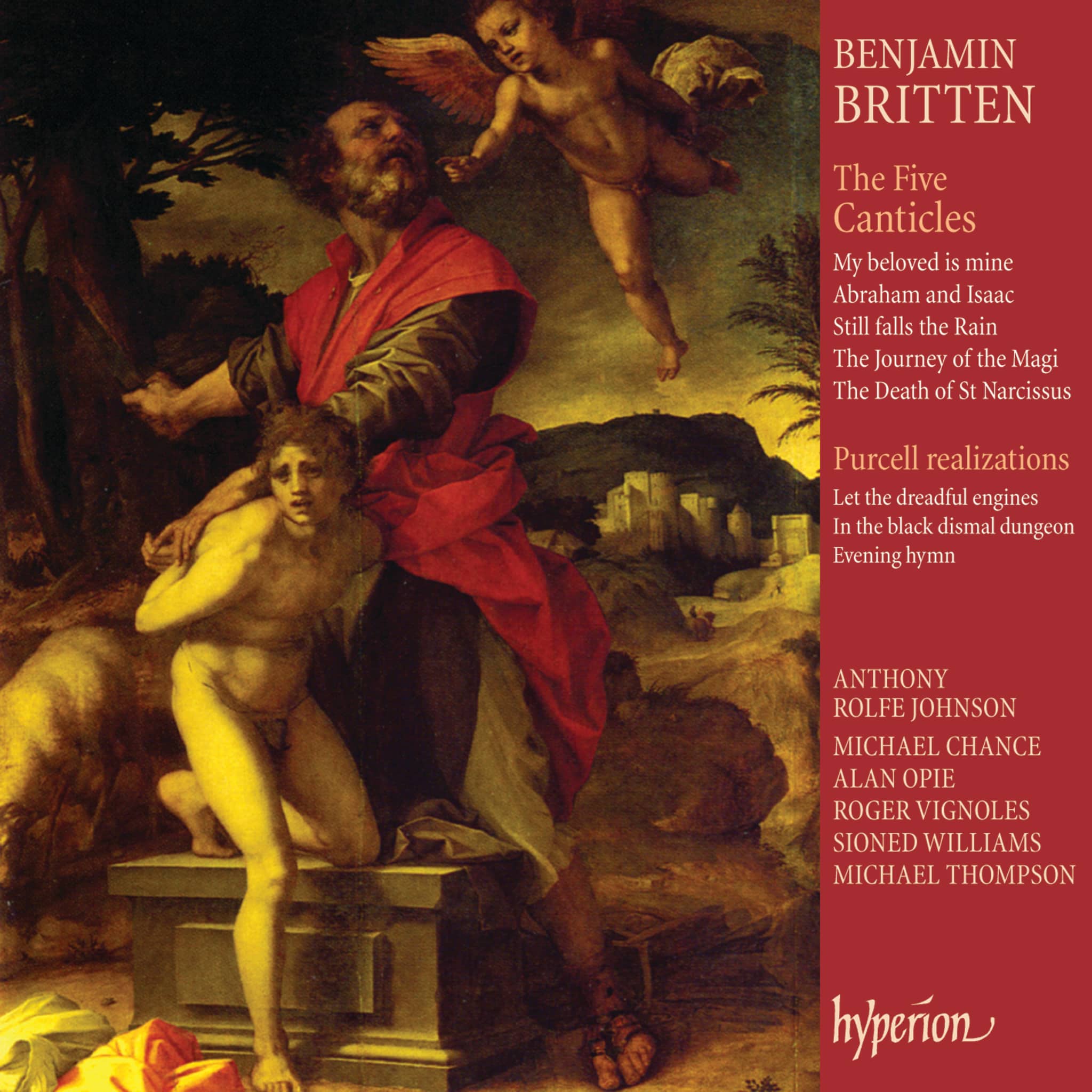






Benjamin Britten's five Canticles were composed independently at different times in his career and were never intended as a unified cycle. Contrary to what the liturgical meaning of the term 'canticle' might suggest, all the works are imbued with a profound religiosity. Some Canticles are composed as memorial pieces and are distinguished by their sophisticated formal structure. These compact cantatas reflect Britten's keen interest in English poetry from various periods.
The first Canticle, "My Beloved Is Mine," was composed in 1947 and performed as a memorial concert in honor of Dick Sheppard, a close friend of Britten's. Its musical basis is a poem by Francis Quarles, which intertwines divine love with imagery of human affection. "Abraham and Isaac," the second Canticle from 1952, was performed by Peter Pears, Kathleen Ferrier, and Britten himself. Here, the biblical narrative is presented in a lively dialogue and with language reminiscent of medieval times. Britten dedicated his third canticle, "Still Falls the Rain," from 1954, to the Australian pianist Noel Mewton-Wood.
It wasn't until 1971 that he wrote his fourth canticle, "The Journey of the Magi," based on a poem by T.S. Eliot and depicting the journey of the Three Wise Men. While recovering from heart surgery in 1974, Britten wrote his fifth canticle, "The Death of Saint Narcissus," as a tribute to his late friend William Plomer. Britten's admiration for Henry Purcell was a recurring theme in his work, as he incorporated Purcell's musical elements and reinterpreted his songs.