Skip to content
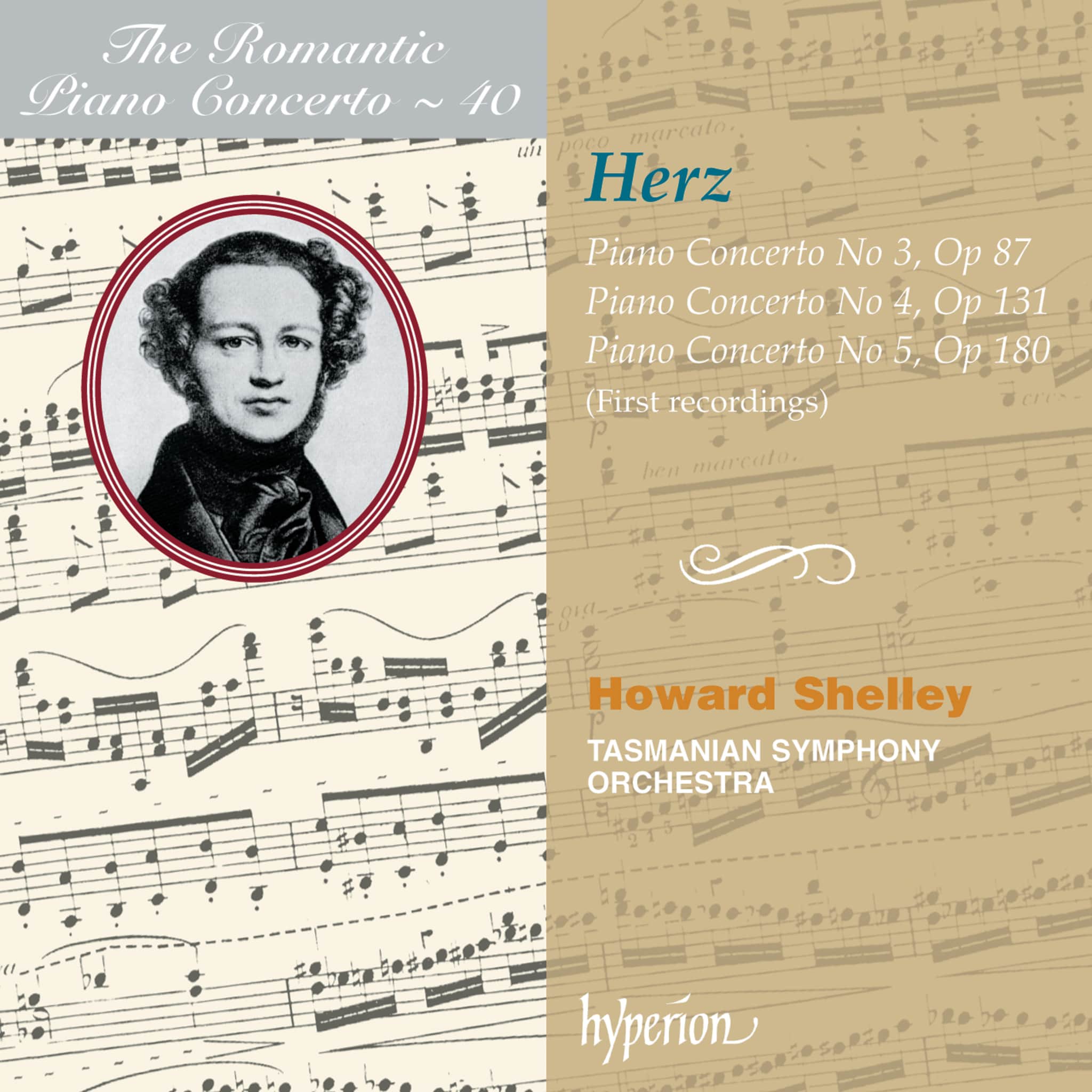
Herz: Piano Concertos Nos. 3, 4 & 5 (Hyperion Romantic Piano Concerto 40)

Herz: Piano Concertos Nos. 3, 4 & 5 (Hyperion Romantic Piano Concerto 40)

Howard Shelley, Tasmanian Symphony Orchestra

Duration70 Min

Born in Vienna, the son of a musician, Heinrich Herz received his first musical lessons as a child. After training with his father and Daniel Hünten in Koblenz, he began his studies at the Paris Conservatoire in 1816, where he was taught by renowned teachers such as Louis Pradher, Anton Reicha, and Victor Dourlen. He was awarded first prize for piano playing in his very first year. The influence of the composer Ignaz Moscheles, whom Herz met in Paris, profoundly shaped him.

After moving to Paris, Heinrich adopted the name Henri and embarked on a multifaceted career as a pianist, composer, teacher, inventor, and piano maker. During the 1820s and 1830s, he was one of the most celebrated pianists and enjoyed great acclaim, although he is less well-known today. His compositions, including piano concertos and variations, were in high demand.

Robert Schumann mocked Herz, while the press, often under the influence of his former publisher, repeatedly treated him disparagingly. Despite financial difficulties, Herz founded his own piano factory, which attracted attention through its innovative designs. An extensive concert tour of the USA was a success, and he received an award at the 1855 World's Fair.

Herz's piano concertos stood out significantly from the works of contemporary German composers. Long considered superficial, the playful spirit and virtuosity of his music are now being rediscovered. The technically demanding concertos reflect his exceptional pianistic abilities.

His third and fourth piano concertos, in particular, demonstrate his melodic creativity and technical skill. Both pieces contain surprising passages and unusual elements that make his works special. The fourth concerto impresses with its vibrant themes and variations, while the fifth surprises with rhapsodic introductions and humorous turns.

Herz masterfully employed pianistic effects and surprised audiences with unexpected stylistic shifts. The rediscovery of his music today reveals the joy and talent inherent in his compositions.