
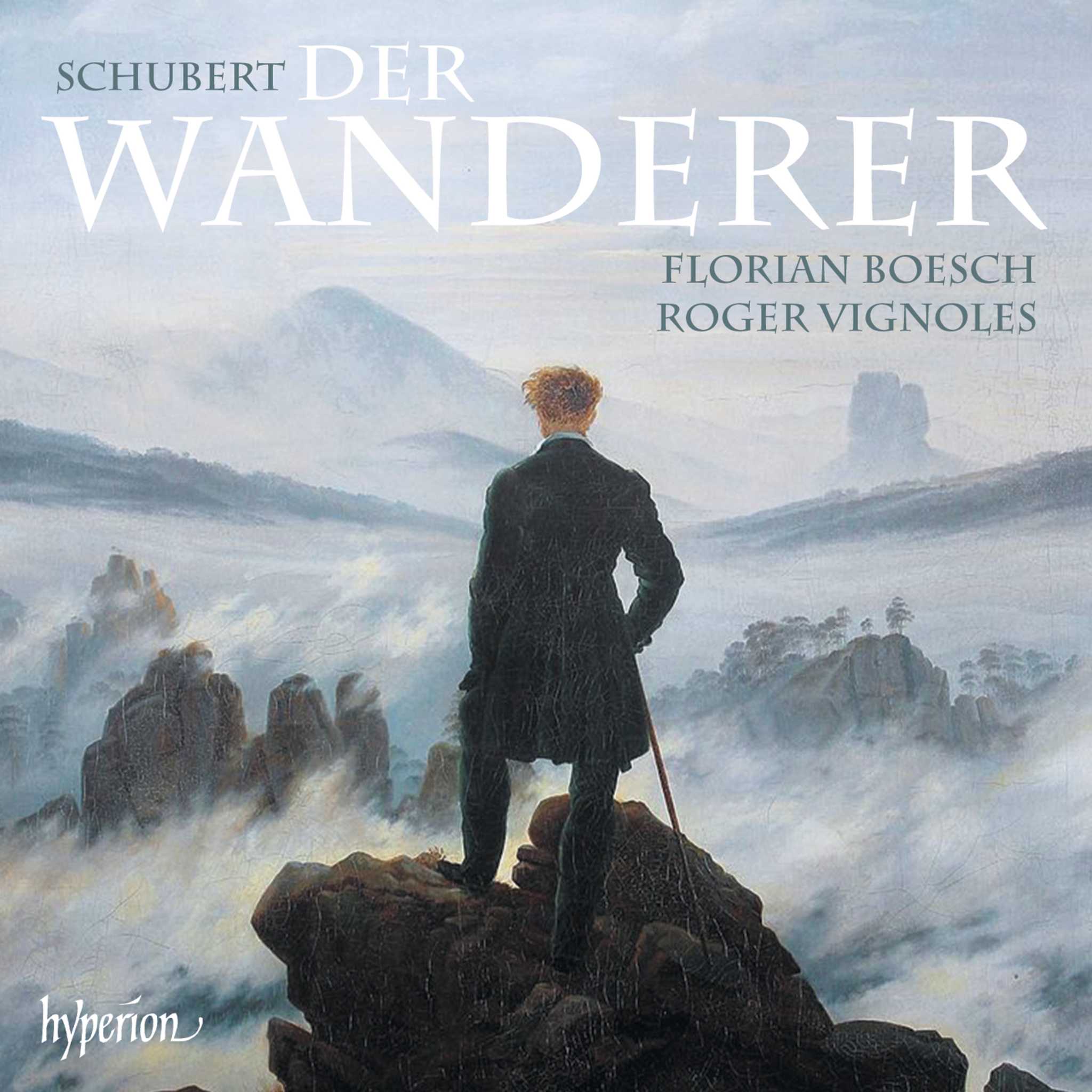








Happiness is often sought in places where we are not currently located – as described in the final lines of "The Wanderer" (the first song) and "The Pilgrim" (the sixteenth song). This motif, which recurs throughout German Romanticism, represents the uprooted outsider, standing on the margins of society, whether by choice or by life's circumstances. A similar mood prevails in Goethe's characters such as the Harper and Mignon, or in the solitary figures of Caspar David Friedrich. This mixture of melancholy, tranquility, and longing for an unattainable foreign land is particularly reflected in Schubert's "Winterreise" and his songs about wandering.
Schubert lived primarily in Vienna, but found the social climate under Metternich after the Congress of Vienna oppressive. In this repressive environment, Schubert and his companions found solace in shared political and artistic ideals and cultivated their friendship, which manifested itself in the Schubertiades. The distance between art and reality, as well as between artist and society, becomes evident in Schubert's song settings.
For Florian Boesch's lecture, the epigraph from Schubert's successful setting of "Der Wanderer" (1816) was chosen. The era is reflected in Schubert's music, which blends Romanticism and melancholy. In social gatherings, Schubert and his friends sought refuge in their artistic and political ideals. The musical structure of the songs, especially melody and harmony, was constantly adapted to new texts.
Schubert's closest circle of friends included figures such as Franz von Schober, Johann Michael Vogl, and Johann Mayrhofer, whose poems inspired many of Schubert's songs. The selection includes Mayrhofer songs from the Heliopolis cycle of 1822, which demonstrate Schubert's growing importance in Vienna and the surrounding region—not least through artists like Vogl.
Schubert's songs explore themes such as nature, homesickness, and the longing for peace. Works like "Der Schiffer" (The Boatman) and "Das Heimweh" (Homesickness) demonstrate Schubert's masterful ability to musically express emotions. His settings of texts by renowned poets like Goethe and Schiller highlight the composer's versatility and creativity.
With his music, Schubert opens up new sonic worlds for his audience—be it the search for an ideal world, the yearning for antiquity, or the struggle with personal crises. His settings of poems often reflect the intellectual currents of his time and are considered pinnacles of Romantic song.