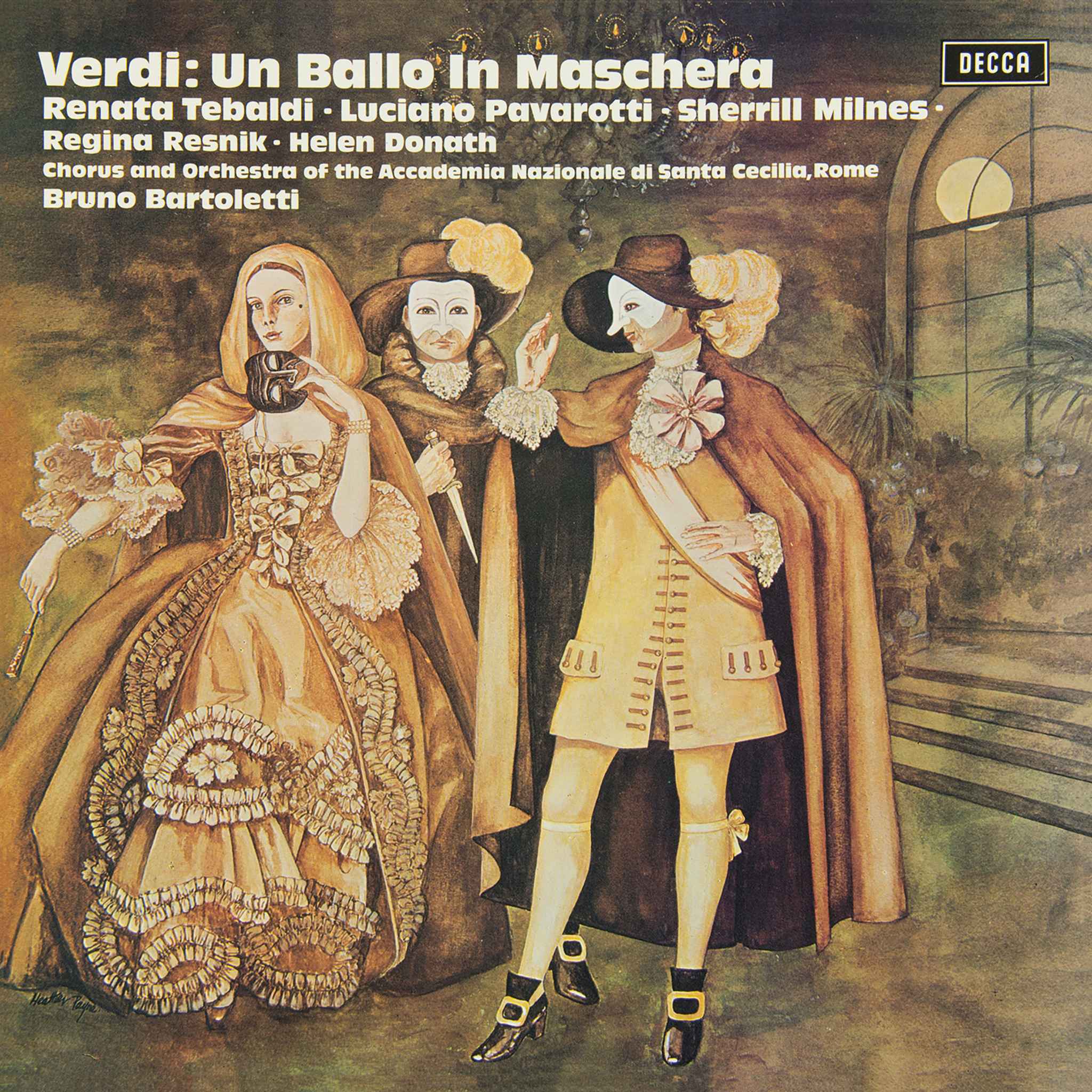
Appears On




AboutRenata Tebaldi
Soprano Renata Tebaldi was born on February 1, 1922, in Pesaro. She came from humble beginnings but still managed to begin studying music at the Parma Conservatory. Initially, she wanted to be a pianist, but then switched to singing and was trained by Italo Brancucci. This was followed by courses with Ettore Campogalliani in Mantua, and later with Carmen Melis in Pesaro. Tebaldi debuted in 1944 at the Teatro Municipale of Rovigo as Helena in Arrigo Boito's "Mefistofele." In the same year, she performed in Parma and Trieste ("Otello," Verdi). After World War II, Arturo Toscanini noticed her and began to promote the young singer's career. In 1946, he engaged her at La Scala in Milan, where on May 11 of that year, she successfully took on the solo part in Verdi's "Requiem" at the concert he conducted for the reopening of the opera house.
From then on, her career progressed rapidly. Tebaldi became one of the stars in Milan, singing there intermittently from 1949 to 1960, and also toured with the ensemble. In 1950, she guested at the Met with La Scala's "Aida," which led to a close and brilliant collaboration. She was invited to the Maggio Musicale Fiorentino with Spontini's "Olympia" (1950) and "Agnes di Hohenstaufen" (1954), and in 1955, she presented an impressive Desdemona in Verdi's "Otello" at the San Francisco Opera and the Metropolitan Opera, which definitively marked her international breakthrough.
Renata Tebaldi became one of the stars on the New York stages, performing 210 times at the Met alone over 17 seasons, including diverse roles such as the leads in "Tosca," "La Traviata," "Aida," and "Madame Butterfly," Mimi in "La Bohème," Ponchielli's "La Gioconda," Cilea's "Adriana Lecouvreur," Maddalena in "Andrea Chénier," Manon Lescaut, Amelia in Verdi's "Simon Boccanegra," Minnie in "La Fanciulla del West," Leonora in "La forza del destino," and Alice Ford in Verdi's "Falstaff." In 1955, she guested at Covent Garden in London, from 1959 onwards also at the Vienna State Opera, and from 1962 at the Deutsche Oper Berlin, in Paris, Rome, Naples, and Barcelona.
From 1956 to 1969, Renata Tebaldi guested annually in Chicago. Tour trips took her to the Teatro Colón in Buenos Aires and the Rio de Janeiro Opera. In 1961, she was a guest in Tokyo and Osaka, and performed in Spain, Portugal, Germany, Holland, France, and repeatedly on extensive tours in North and South America. After 18 years as a member of the Metropolitan Opera ensemble, she sang Desdemona in Verdi's "Otello" there for the last time in 1973. In the same year, she officially retired from the stage, although she occasionally performed in concerts afterward. In 1976, she embarked on another journey, singing several concerts during a tour of the USSR. However, since the mid-seventies, she had largely lived in seclusion in Milan. On December 19, 2004, Renata Tebaldi died after a long illness at her home in San Marino.
Renata Tebaldi's musical legacy is extensive. Numerous complete opera recordings document the great stylistic and interpretive range of one of the most important sopranos of the last century. These include classics such as "La Bohème," "Tosca," "Madame Butterfly," "Aida," "Suor Angelica," and "La Wally." Already in 1958, she received her first Grammy in the category "Best Classical Performance - Vocal Soloist" for her "Operatic Recital," and two years later, she was among the core artists conducted by Erich Leinsdorf, who received the Grammy for "Best Classical Opera Production" for Puccini's "Turandot."
6/2005