Skip to content
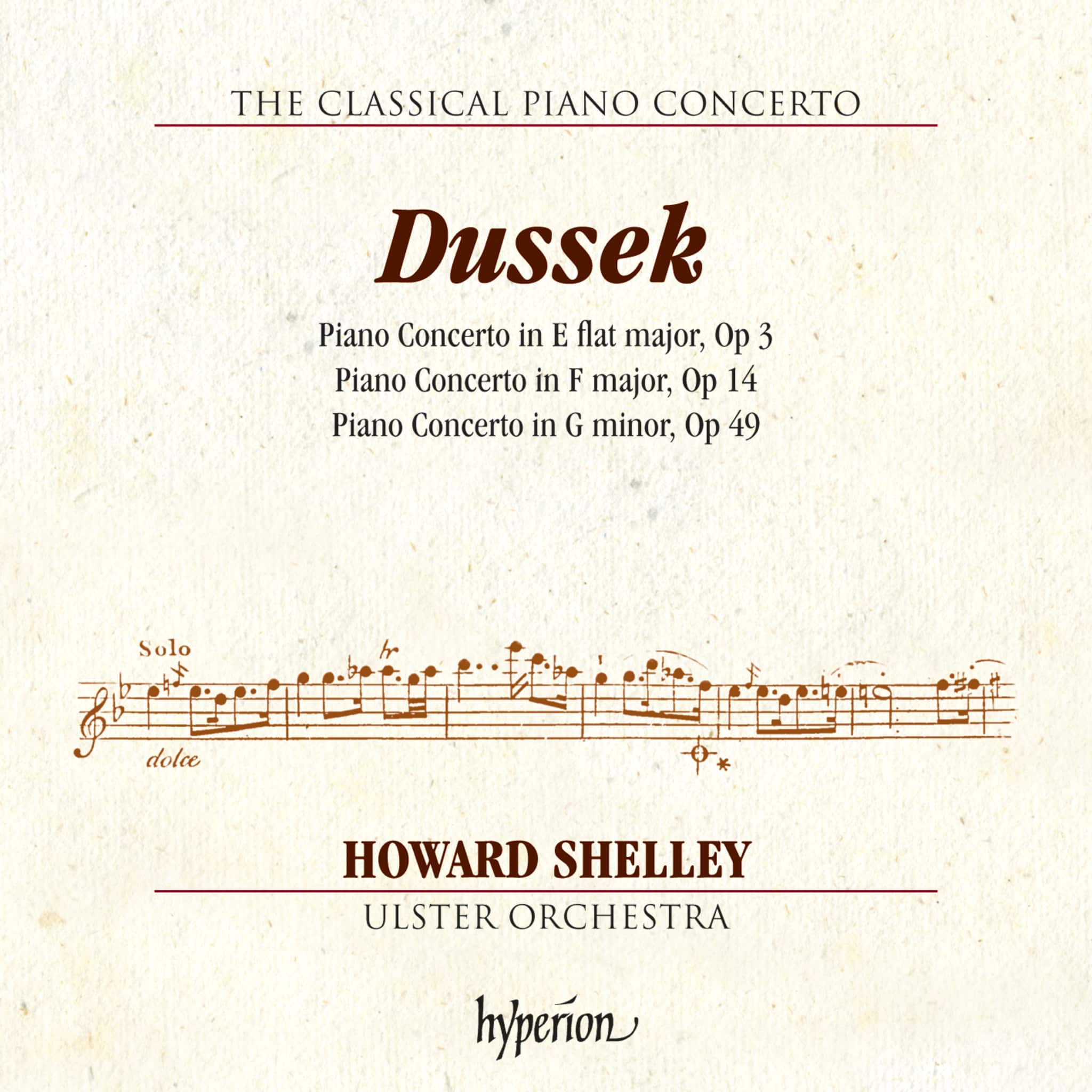
Dussek: Piano Concertos Op. 3, 14 & 49 (Hyperion Classical Piano Concerto 5)

Dussek: Piano Concertos Op. 3, 14 & 49 (Hyperion Classical Piano Concerto 5)

Howard Shelley, Ulster Orchestra

Duration74 Min

Album insights

In the world of classical music, two remarkably popular romantic concerts once stood out. Scharwenka's First Concerto and Rubinstein's Fourth gained widespread acclaim over the years, arguably outshining any other works in the genre except perhaps Henselt's Concerto in F minor. These composers shared more than just their success as glamorous virtuoso pianists. Both penned a short piano piece at the start of their careers that became globally recognized, coincidentally both labeled with the same Opus number. Scharwenka created his Polish Dance in E-flat major, Opus 3, No. 1 in 1869, humorously referring to it later as his "silly dance." Rubinstein's Melody in F major, Opus 3, No. 1, composed in 1852, was even more pervasive. Despite their fame during their lifetimes, average music enthusiasts today mostly recall these two solely for their respective musical "hits," as little of their vast repertoire survived beyond the first half of the twentieth century. Another unexpected common thread between them was their founding of successful piano conservatories—Rubinstein established the Imperial Conservatory in St. Petersburg in 1862, while Scharwenka founded the eponymous institution in Berlin in 1881, growing to become one of the world's largest music schools by 1893 with forty-two soundproof rehearsal rooms, sixty-two teachers, and a thousand students. Born on January 6, 1850, in Samter, Franz Xaver Scharwenka, along with his brother Ludwig Philipp, did not hail from a wealthy family despite their aristocratic appearance captured in photographs. Xaver's musical talent surfaced at the age of three when he started playing by ear. The family's move to Berlin in 1865 saw Xaver and his brother enrolled at the New Academy of Music under the tutelage of Theodor Kullak alongside classmates Alfred Grünfeld and Moritz Moszkowski. Scharwenka's career began to take shape rapidly as he made his debut with Mendelssohn's D minor Concerto in 1867, eventually joining the faculty of the Berlin Academy. Not long after, his early compositions were published, leading to the creation of his renowned B minor Piano Concerto, dedicated to Liszt. Over the ensuing years, Scharwenka's concert activities, tours, teaching engagements, and composition work flourished. He revised his B minor Concerto during his military service between 1873 and 1874, finally performing it with an orchestra on April 14, 1875, under the baton of Julius Stern, marking a moment of pure joy in his life. Scharwenka continued to refine and present his concerto, gaining recognition and acclaim worldwide, with Liszt himself acknowledging and recommending the work for performance. Scharwenka's B minor Concerto, characterized by its three movements deviating from the traditional fast-slow-fast structure, provides an engrossing musical journey. The elegiac Adagio intertwines with the tempestuous opening movement, setting the stage for a brilliant Scherzo-Rondo requiring nimble virtuosity and contrasting the work's mainly dramatic nature. The concluding Allegro non tanto returns to the initial mood, offering technically demanding challenges for the pianist. Through captivating thematic development and masterful orchestration, Scharwenka's concerto concludes victoriously, leaving a lasting impression. Lauded by fellow musicians and critics alike, Anton Rubinstein's legacy as a pianist, composer, conductor, and educator remains unparalleled. Renowned as the "Michelangelo of Music" by Hans von Bülow, Rubinstein's contributions to the musical landscape were vast and influential. Both revered and criticized for his compositions, Rubinstein's works exuded melodic richness yet often lacked the restraint and self-critique essential for true greatness according to Grove's Dictionary of Music and Musicians. Anton Rubinstein, resembling a young Beethoven, hailed from a prosperous Jewish merchant family, moving to Moscow at a young age to commence his musical journey. After extensive travels and studies in Europe, Rubinstein founded the Imperial Conservatory in St. Petersburg in 1862, ushering in a new era of musical education in Russia alongside his brother Nikolai, who established the Moscow Conservatory in 1866. With five piano concertos crafted between 1850 and 1874, Rubinstein's D minor concerto showcases his signature melodic prowess and virtuosic writing. The concerto, characterized by a dramatic first movement, a lyrical Andante in F major, and a lively finale, epitomizes Rubinstein's unique compositional style and musical depth. Dedicated to Ferdinand David, the work encapsulates the brilliance and vitality for which Rubinstein's music is celebrated. Jeremy Nicholas © 2005

Translation: Anne Steeb/Bernd Müller