Skip to content
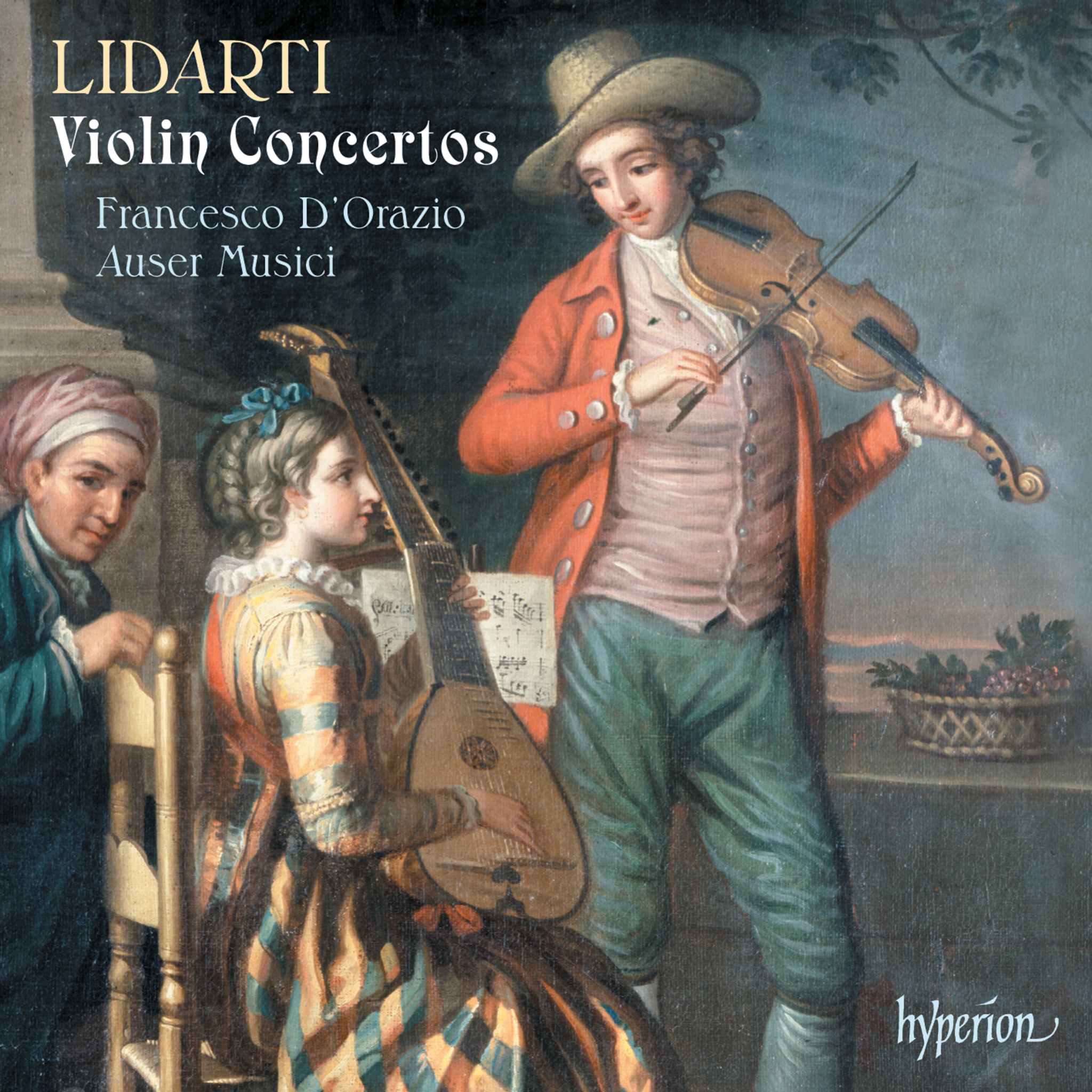
Christian Joseph Lidarti: Violin Concertos

Christian Joseph Lidarti: Violin Concertos

Francesco D'Orazio, Musici

Duration62 Min

Migration was a defining element in 18th-century European music. While many musicians emigrated from Italy, talented musicians from northern regions were drawn to Italy. A pioneer of this movement was Cristiano Giuseppe Lidarti, an Austrian composer of Italian descent, who traveled to Italy in 1751 and settled there permanently.

Lidarti was born in Vienna on February 23, 1730. He initially received his musical training from his relative Giuseppe Bonno, whom he referred to as "Uncle," even though Bonno was his cousin. Bonno directed the imperial court orchestra and had studied with Leonardo Leo. Lidarti's education initially encompassed philosophy and law at the University of Vienna, while simultaneously learning the harp and harpsichord. In Italy, he originally intended to deepen his composition skills with Niccolò Jommelli, a goal he finally achieved in Rome in 1757. After stays in Venice and Florence, he worked for five years as a music teacher in Cortona before taking up a position as an instrumentalist (double bass/cello) at the church of Santo Stefano dei Cavalieri in Pisa in 1784. He remained there for almost four decades until his death in 1795.

Our knowledge of Lidarti's life comes primarily from his autobiography, "Aneddoti musicali," written in 1774. He corresponded with prominent musicians of his time, such as Padre Martini, Jommelli, and the English music biographer Charles Burney, who met him in Pisa in 1770. These letters attest to the high esteem in which Lidarti was held both as a performing musician and as a composer. He became a member of the prestigious Accademia Filarmonica in Bologna and the Academy of Modena.

His compositional output focused mainly on chamber music and concertos. His oratorio "Ester," composed in 1774 with a Hebrew libretto for the Jewish community in Amsterdam, is noteworthy – presumably the first oratorio in Hebrew. The score was long thought lost until its rediscovery in London in 1997. His last known composition dates from 1793.