Skip to content
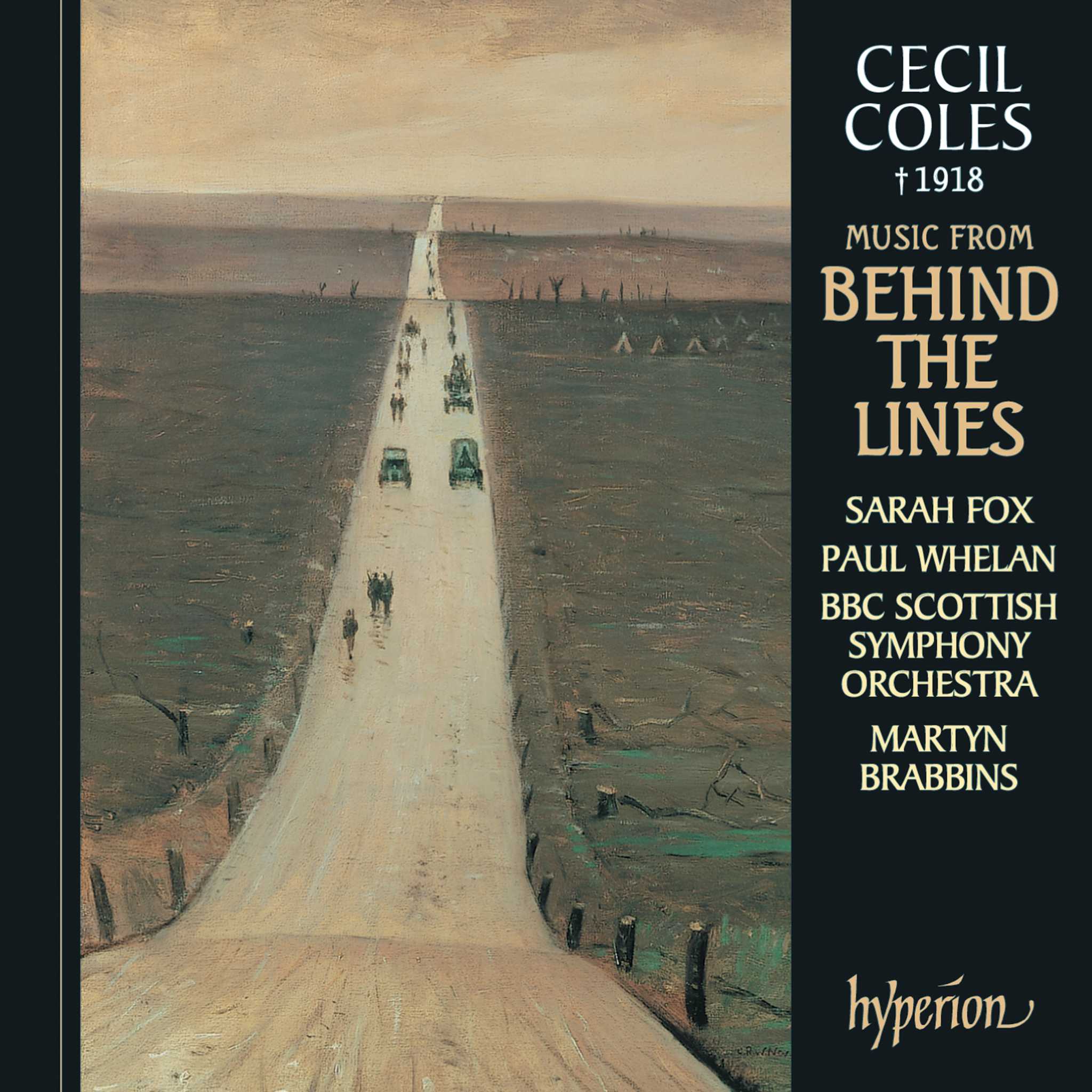
Cecil Coles: Music from Behind the Lines

Cecil Coles: Music from Behind the Lines

BBC Scottish Symphony Orchestra, Martyn Brabbins

Duration63 Min

Album insights

It is often assumed that composers who write outstanding and original music for a specific instrument are also gifted performers themselves. Consider Mozart's, Chopin's, or Rachmaninoff's piano music—without an understanding of their parallel abilities and personalities as skilled pianists, it is hard to imagine. Their playing technique surely influenced how they composed for keyboard instruments. However, documented and anecdotal evidence about Carl Nielsen suggests otherwise. Wax cylinders discovered recently in the Statsbiblioteket archives in Aarhus contain two short pieces played by the composer himself, indicating Nielsen's piano technique may have been of varying quality at best. Nielsen's daughter Anne-Marie Telmányi recalled an incident during a Paris visit in 1926, where he, along with other prominent musicians, attended a reception. Following Ravel's performance of a technically demanding work, Nielsen surprised everyone by playing a Mozart fantasy instead of one of his own compositions—a moment that perhaps revealed his limited ability as a pianist.

Yet Nielsen's shortcomings as an interpreter by no means limited his talent for composing piano works. His lack of practical experience seemed to free rather than restrict his compositional imagination, making his piano works among the most original and unconventional in keyboard literature. Nielsen's idiosyncratic musical language is easily recognizable in his works, reflecting a childlike joy in exploration and invention—a reflection of his earliest experiences with the instrument. Nielsen described playing a harpsichord in his parents' home in his 1927 autobiography, signifying his musical journey from a young age.

A fundamental duality runs through much of Nielsen's piano music: a tactile sense of exploration on one hand, fingers physically moving across the keys, relishing in the feeling of weight and articulation associated with certain musical phrases and gestures; and on the other hand, a sense of imagination and adventure, exploring musical thoughts whose origins lie beyond a pragmatic claim to practical execution, leading to entirely new realms of character and expression.

This duality is reflected in the two categories of works Nielsen created for the piano. The first category primarily consists of educational compositions and occasional works—pieces intended mainly for amateur pianists and especially children. These pieces were deliberately made easily understandable, stylistically simple, and technically accessible, while often harboring a tendency towards more complex and idiosyncratic impulses beneath the musical surface. The second category consists of large-scale pieces comparable to Nielsen's symphonies and concertos, featuring a more challenging and avant-garde musical language. Both categories, however, contain the same wealth of ideas. Nielsen's first published piano work, the Five Piano Pieces op. 3, mostly belongs to the first category. Nielsen may have composed two of the pieces, No. 2 and No. 5, between 1887 and 1889. The complete collection, however, was assembled between 1890 and 1891 during Nielsen's first trip outside Denmark. The collection is characterized by a wide range of moods and expressions.

Nielsen made his mark in the 1890s as a composer and established himself as the leading voice of modernism in the Danish music scene. Nielsen's third piano composition from the 1890s, the Humoresque-Bagatelles op. 11, falls into the category of shorter character pieces, contrasting with his larger and more complex works. Despite facing initial criticism comparing them unfavorably to Schumann's Kinderszenen, these pieces resonate with influences from 20th-century composers like Bartók, Prokofiev, or Debussy. The first piece, "Goddag! Goddag!" is a playful Allegretto mimicking the Danish greeting "Good day! Good day!". The suite culminates in an almost Mozartian gesture in the final piece, "Spilleværket" ("The Music Box"), looking ahead to Nielsen's grand comic opera "Maskarade."

Nielsen marked the turn of the century with two short occasion pieces. The Fest-Præludium ved Aarhundredskiftet ("Festival Prelude at the Century's Turn") exudes a jovial spirit featuring extended octaves and chords, dedicated to his close friend, the visual artist Jens Ferdinand Willumsen. The second piece, Drømmen om "Glade Jul" ("The Dream of 'Silent Night'"), is an improvisatory paraphrase based on the Christmas carol "Silent Night," exploring new and unconventional musical terrain.

For the next decade, Nielsen did not compose further piano works, focusing instead on his operas, symphonies, and violin concerto. His return to the piano in 1916 produced two large-scale pieces, Chaconne op. 32 and Theme and Variations op. 40, showcasing Nielsen's interest in older musical forms and baroque counterpoint. The Chaconne, inspired by Bach's famous work for solo violin, unfolds a structured development of themes, culminating in a moment of balance and stability. The Theme and Variations op. 40 follows a similar concept, demonstrating Nielsen's structural modulation and increasing intensity throughout the variations.

The Suite op. 45, perhaps Nielsen's most significant piano work, exhibits an overarching tonal development focused on B major as the central tonality. This suite showcases Nielsen's fusion of baroque counterpoint, Mozartian elegance, and Haydnesque inventiveness, encapsulating a wide range of styles and influences.

Nielsen's Three Piano Pieces op. 59, composed in 1928 but published posthumously in 1937, represent a concentrated essence of his earlier works. These pieces demonstrate a carefully constructed harmonic progression, leading to unexpected and dramatic conclusions. Nielsen's music embodies influences from contemporary modernists like Schoenberg and Stravinsky, showcasing innovation and creativity.

Despite being considered Denmark's most celebrated composer of his time, Nielsen continued to engage with wider musical circles. His collection Klavermusik for små og store op. 53 ("Piano Music for Small and Large") stands as a significant contribution, displaying his genius in compact pieces for both children and adults. Nielsen's piano works embody a comprehensive journey through various styles and creative pursuits, reflecting the depth of his compositional brilliance.