
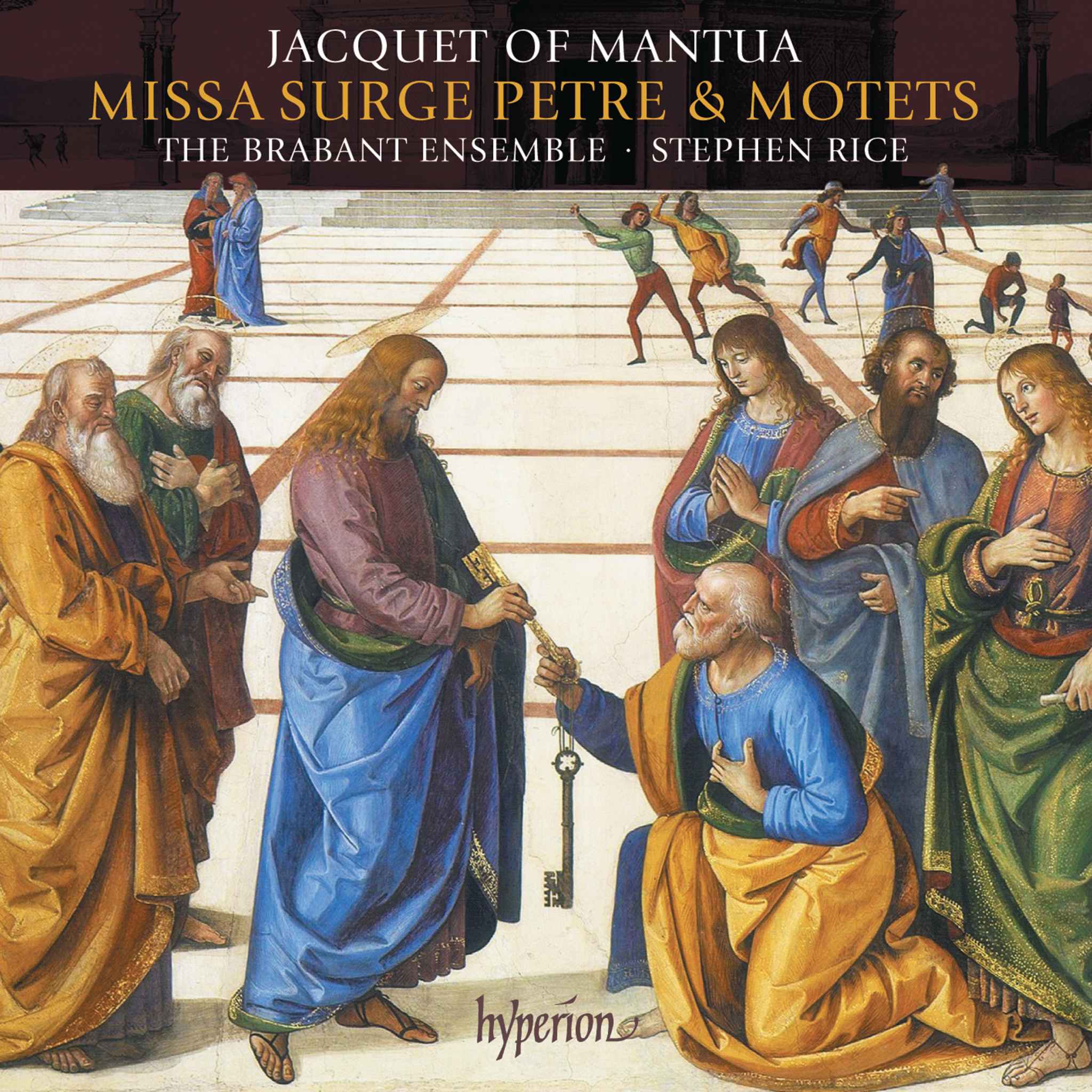



Jachet of Mantua, whose real name was Jacques Colebault from Vitré in Brittany, was a significant Renaissance composer whose various name variations, such as Jachet de Mantoue, Iachet da Mantova, or Iachetus Gallicus, often caused confusion. His identity was further complicated by the existence of the contemporaneous composer Jachet de Berchem. For over three decades, Jachet lived and worked in Mantua, where he was supported by Cardinal Ercole Gonzaga, although the cathedral chapter did not grant him any financial recognition.[1][4]
The Gonzaga dynasty experienced its cultural heyday through Isabella d’Este, who, after her marriage to Francesco Gonzaga, transformed Mantua into a center for music and art. Jachet rose to become the leading composer for the Church there, creating numerous masses, motets, hymns, and passions of high quality, even though they are rarely performed today.[1]
[1] His works for the choir of Mantuan Cathedral, often for large ensembles, are remarkable despite their limited dissemination. Jachet focused primarily on sacred music, leaving secular compositions to others. Many of his pieces remain unpublished to this day.[1][2]
A prime example is the six-part Missa Surge Petre, in which he artfully incorporates motifs from his motet of the same name and musically reflects various stages in the life of the Apostle Peter.
Other motets and works by Jachet are subject to inconsistent attributions in music history. His composition Domine, non secundum peccata nostra from 1535 stands out in particular for its innovative beauty and masterful command of form.[2]