
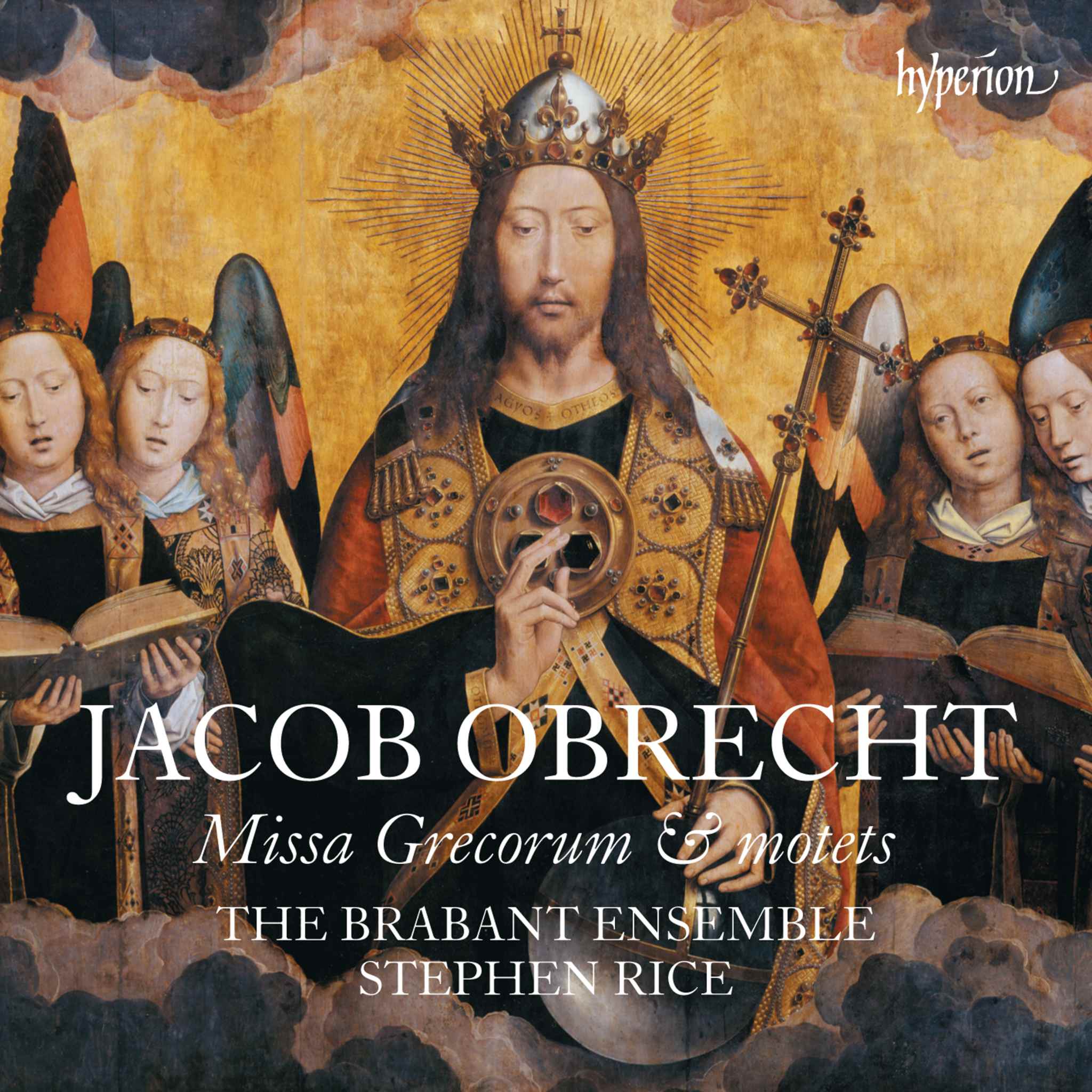



The title of the Missa Grecorum: Why does it bear this name? There is no definitive answer. In his preface to the current recording, Thomas Noblitt mentions the fruitless efforts of various scholars to determine the origin of this Mass. The cantus firmus of the Mass appears to be of secular origin, as suggested particularly by its rhythmic structure. The "Greek" element could be related to the Vatican tradition of conducting Greek readings during Eastertide. This hypothesis is supported by the use of the Easter sequence "Victimae paschali laudes." The "Grecorum" melody is most clearly audible in the Agnus Dei, where the upper voice presents it in its entirety.[1] Edgar Sparks emphasizes Obrecht's use of sophisticated transformation techniques such as augmentation, inversion, and retrograde motion in various sections of the Mass.
Obrecht's derivation of musical material from the tenor part shows similarities to later techniques of the Second Viennese School. Anton Webern wrote his dissertation on works by Obrecht's contemporary, Heinrich Isaac. The formal processes form the framework into which Obrecht integrates his counterpoint. The auditory impression arises from harmonic and structural variations, which bring Obrecht's musical maturity and sense of proportion to the fore.
The Kyrie and Gloria demonstrate Obrecht's masterful use of the cantus firmus in different musical structures. In the Kyrie, a reduced instrumentation suggests a trio, while rhythmic variations indicate increasing complexity. In the Gloria, the cantus firmus appears in various imitative forms, with the movement concluding in a lively triple meter.
The Credo begins recitatively and develops into a compact narrative, leading to a vibrant "Et resurrexit" with unison and octave imitations from the Gloria. The Sanctus, with its four sections and the longest arc of tension, represents a high point of the Mass. The Agnus Dei concludes the Mass with changing instrumentation and displays typical compositional characteristics of Obrecht.
The Missa Grecorum is dated to around 1490[2]; Obrecht was employed in various positions in Europe until his death in 1505[4]. His extensive output demonstrates the versatility and innovative power of this composer, who is brought closer to today's audience through this recording.
The extended motet O beate Basili and the fragmentary Mater Patris offer a complex tapestry of textures and demonstrate the masterful fusion of text and music. The Salve Regina and the Agnus Dei represent further examples of Obrecht's diverse output and enrich his extensive repertoire.